

Broad learning outcomes
- Students will recognise that people with disability are important members of our diverse community.
- Students will recognise the need for accessibility and inclusion.
- Students will recognise common myths and misconceptions about disability.
- Students will understand the importance of removing barriers for people with disability and ensuring everyone has an opportunity to participate.
Information Kit

Information kit for Schools
The kit helps schools support International Day of People with Disability by raising awareness, promoting inclusion, and offering classroom resources, event ideas, and ways to engage students and the wider community.
English activities
- Write a short story about a visit to your favourite place. You cannot describe how the place looks: you must describe how it smells, sounds and feels.
- Interview a person with disability, then present the interview as a magazine or newspaper article. Include pictures or photographs where possible. Publish the article in the school newsletter or on the school website or social media pages.
- Analyse how people with disability are portrayed in the media and popular culture (TV, movies, music, books etc.). Do you think these portrayals are accurate? Discuss the findings.
- Split into groups and research a disability. Present your learnings to the class, including how it has changed your assumptions about disability.
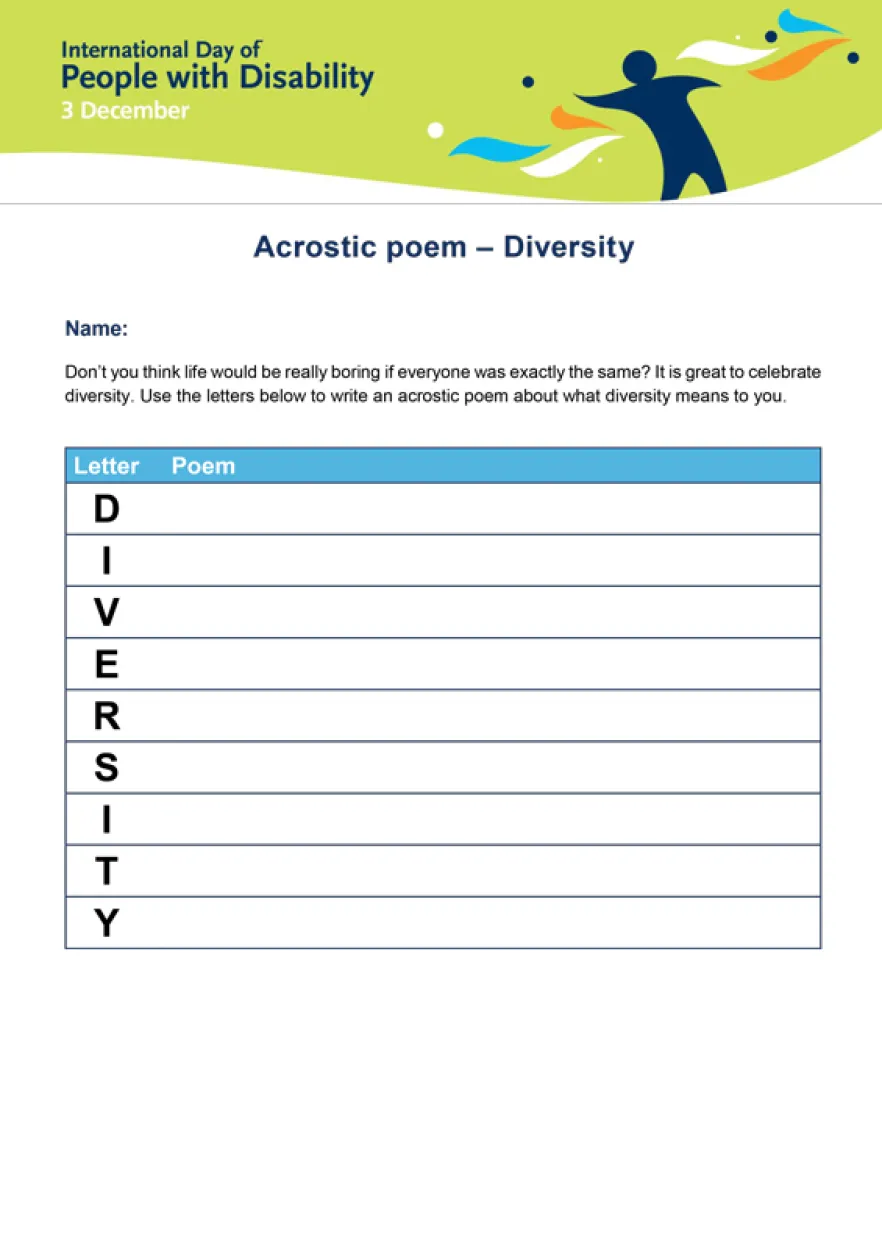
- Promote diversity by completing the Acrostic poem – Diversity activity sheet
- Explore ‘able’ words by completing the A celebration of ability – word match or A celebration of ability – missing letters activity sheet. Note: select the one that is most appropriate for your learning level.
- Experience a different form of communication (Braille) by completing the Communicating with Braille activity sheet.
- Use your creative thinking skills to complete the Brainstorming activity sheet.
- Participate in a class discussion about facts and myths using the statements on the True or false activity sheet.


Communicating with Braille
Experience a different form of communication (Braille) by completing this activity sheet.
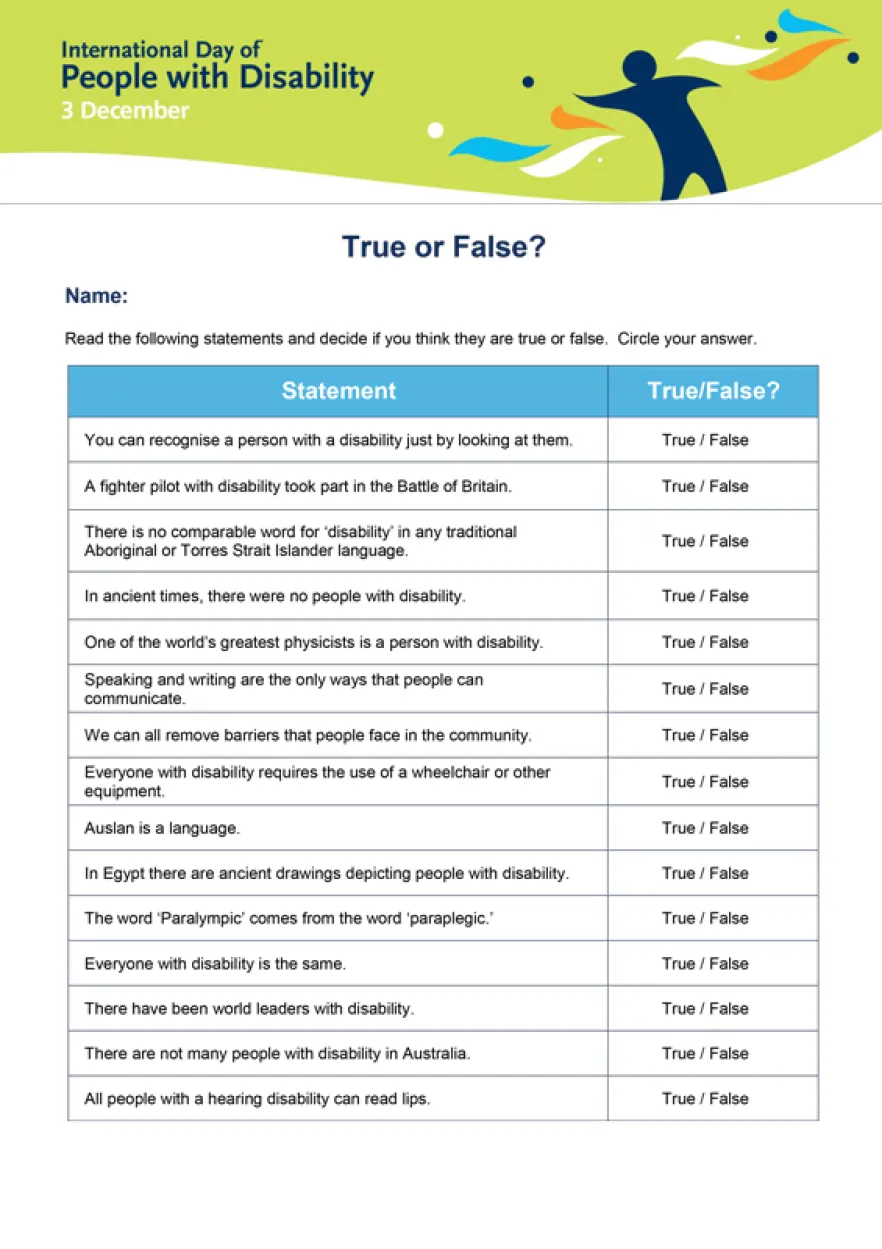
True or false activity sheet
Use this activity to lead a classroom discussion about facts and myths using the true or false sheet.
History
- Research the history of the disability rights movement and how disability has been portrayed. How has this changed over the last century? Who are some people that have raised awareness and made progress in these areas?
- Research the lives of people with disability over the last century and how they might have changed. Discuss inventions or technologies that have been developed to improve accessibility for people with disability.
- Explore the lives of some historical figures with disability by completing the Match me activity sheet. Discuss how disability might have affected the occupation of each person.

Match me up – History activity sheet
Explore the lives of some historical figures with disability by completing the Match me activity sheet. Discuss how disability might have affected the occupation of each person.
Maths activities
- Find some statistics about people with disability and present the information in graph format. You will find some interesting statistics on the Australian Bureau of Statistics website.
- Create a scale map of your school and label all the areas which do or do not cater for people with disability. Design a new map of your school with suggested improvements.
Science/Technology activities
- Research the barriers people with disability may encounter. For example, find out about gradients and materials that block sound and light.
- Discuss the five senses. For what purposes do we use each one? How do you think we would adapt if we were relying on one or two senses? Complete the listen and sniff activity sheet.
- Use your five senses to complete the senses scavenger hunt activity sheet.

Listen and sniff classroom activity
Discuss the five senses. For what purposes do we use each one? How do you think we would adapt if we were relying on one or two senses?
The arts
- Create large posters inviting people to observe International Day of People with Disability. Place them around the school for parents and visitors to see.
- Research famous artists with disability and try using their methods or painting in their styles.
- Brainstorm and research ways in which people who are deaf enjoy music. Consider vibrations and movement.
Health and Physical Education
- Work in small groups to modify your favourite sport or activity so it is accessible for people with disability. For example, modify dodge ball so everyone is sitting down instead of standing.
- Research one sport from the Paralympic Games. Share your learnings with the rest of the class.
- Discuss the question ‘What does it mean to have disability?’. Record the responses and discuss any stereotypes or generalisations that come up. This should be an open and honest discussion without judgement.
Additional Resources
You can find more activities for kids below, including colouring in, chatterbox origami or decorate your classroom with posters and paperchains.
You can check out online resources, such as TED Talks or YouTube, to find some great videos, short films, articles and podcasts about disability and the experiences of people with disability. Use these resources to start a conversation about disability in the classroom to challenge perceptions, normalise disability and grow inclusion.


Chatterbox origami
Our chatterbox is made from folding a paper template to create a pyramid-like structure that has flaps that open to reveal IDPWD messages.

Editable poster templates
Use these A3 poster templates to promote IDPwD events in your classroom, community or workplace.
Editable flyer template
Use this A5 flyer template to promote IDPwD events in your classroom, community or workplace.
Editable eNewsletter graphic templates
Use the eNewsletter graphic templates to promote IDPwD events and initiatives in your school, community or workplace.
Last updated:
Audience:
Schools